
Poseidon: protecting the lung of the Mediterranean

Under the Mediterranean lies one of the most valuable marine ecosystems: the Posidonia meadows. This marine plant, whose scientific name is Posidonia oceanica, has the capacity to build true underwater forests that provide numerous benefits: shelter, food, and breeding areas for other species. It also produces oxygen, captures carbon dioxide, and protects from coastal erosion.
And how do we obtain all this information? How do we know how much Posidonia there is? What species inhabit it? What conservation status have the meadows?
To answer all these questions and learn about the characteristics of this endemic plant of the Mediterranean, from Anèl·lides we have launched a new monitoring phase of the Posidonia Activa project. This year, the study of the meadows, called Poseidon, has been possible thanks to the support of Prodeco Pharma and Sea the Change and in collaboration with the Badalona City Council and the Blaumar Mataró diving center.
Know to protect
Posidonia oceanica is an endemic plant of the Mediterranean that plays a fundamental role in the functioning of coastal ecosystems. Its roots and rhizomes help to fix the sediment, and its leaves reduce the energy of the waves, helping to slow down the erosion of the coast.
Despite its importance, it is a particularly vulnerable ecosystem. The anchoring of boats, pollution, loss of water quality, urbanization and transformation of the coast, invasive species, and the increase in sea temperature can affect these meadows. In addition, its growth is very slow, meaning that the impacts they suffer can take decades or even centuries to recover.
That is why it is essential to have data that allows us to know its status and follow its evolution.
Poseidon
In this new phase of the Posidonia Activa project, the Poseidon study has focused on the coast of Mataró. Prior to sampling, a prospecting dive was carried out to learn about the characteristics of the meadow: depth, distribution and environmental conditions. With all this information, the most representative areas were selected, on which the study would focus.
In June of this year, two scientific dives were carried out:
- One focused on the conservation status of the meadow, where coverage and density measurements were taken to have a more complete view of the structure of the meadow and thus establish a base of reference.
- The other focused on studying the biodiversity associated with it.
They were carried out thanks to 10 volunteers, through autonomous diving, who collaborated in the observation and data collection tasks. The dives were carried out from the boat of the BlauMar Mataró diving center, which provided logistical support and knowledge of the area.
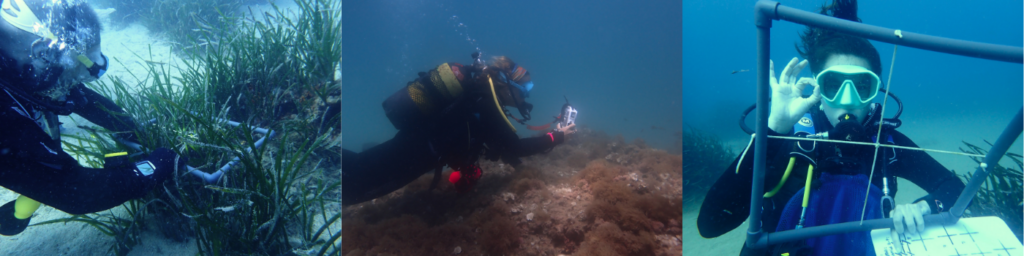
What have we found under the waters of Mataró?
Regarding the structure of the meadow, the data obtained show fragmentation and heterogeneity, with sectors where Posidonia is abundant and others where its presence is scarcer.
Regarding the associated biodiversity, 84 different species were identified, including algae, fish, bryozoans, molluscs, tunicates, sponges and some annelids.
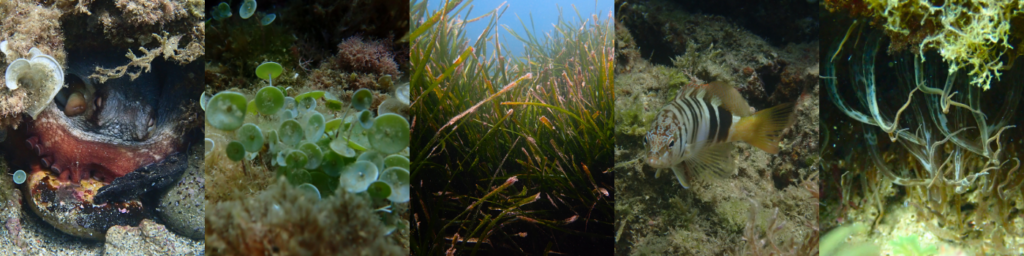
All this biodiversity highlights the importance of the meadow as a habitat for numerous species, since it offers spaces for refuge, feeding, reproduction and growth. To document this marine community, photographic records were made during the dives, which were later incorporated into the MINKA citizen science platform to facilitate their identification, validation and monitoring.
Thus, the data obtained allow us to better understand both how the meadow is structured and all the life that finds refuge there, establishing an initial knowledge base that will be especially valuable when it can be compared with future monitoring.